What kinds of work can be settled on Idios?
Anything you'd pay someone else to do. The contract doesn't care what the work is, it just escrows payment, verifies delivery, and settles. Examples include AI inference and model training, scientific compute and simulations, 3D rendering, data labelling and annotation, code review and security audits, translation and transcription, and anything you'd pay a freelancer for.
Why Beam, not Ethereum?
Beam's MimbleWimble protocol hides amounts and identities at the base layer. On Ethereum you'd need ZK rollups or mixers to approximate this, and the rollup adds cost, complexity, and a bridge. Beam already gives you the privacy primitives natively. Idios just needed to build escrow on top.
What assets can I pay in?
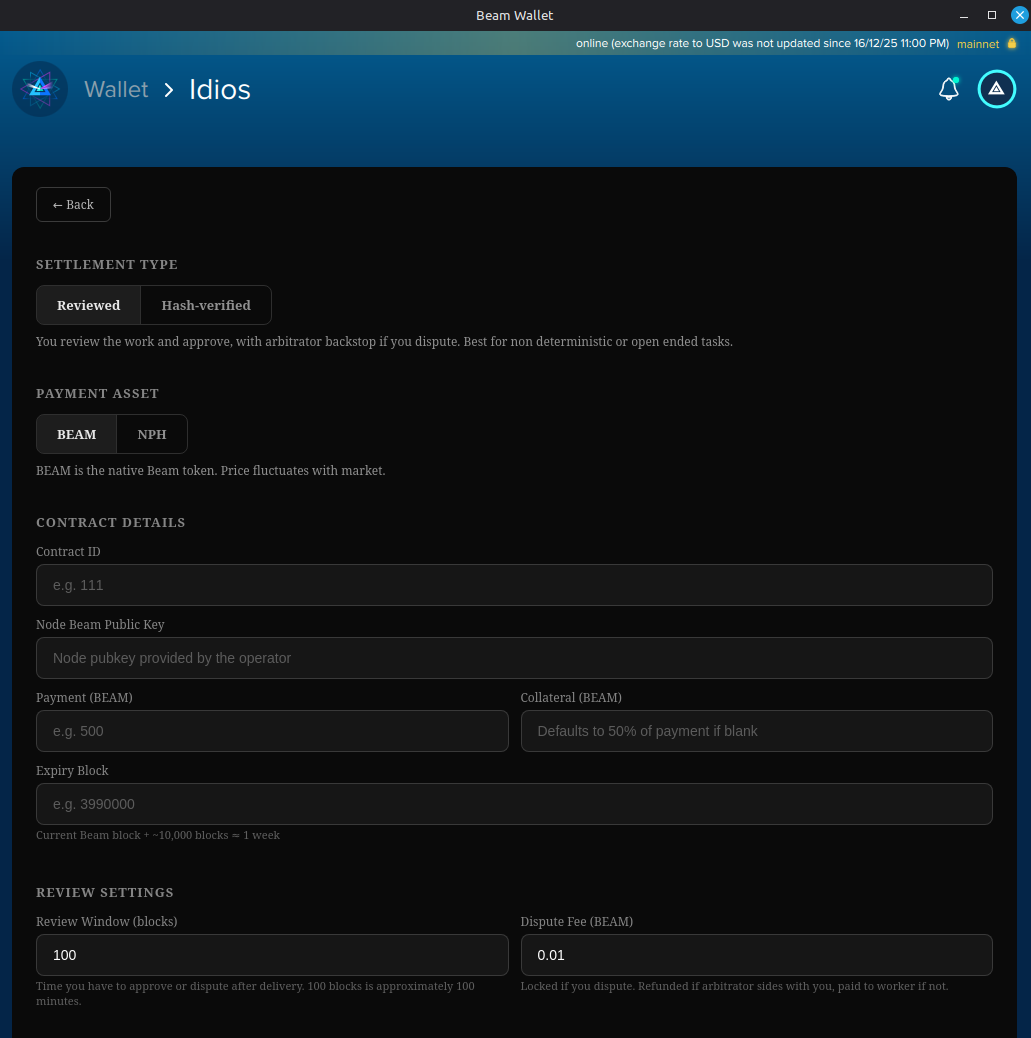
BEAM (the native asset) or NPH. NPH is a USD-pegged confidential stablecoin minted by the Nephrite protocol on Beam. It gives you the price stability of a stablecoin while keeping amounts and counterparties private at the protocol level. Both assets share the same confidentiality properties, neither has a central issuer that can freeze addresses, and both are usable in any Idios contract.
Is this trustless?
Partially. Mode A is fully trustless: settlement requires a hash match, no third party can intervene. Mode B introduces an on-chain arbitrator who can resolve disputes if the requester and worker disagree. Dispute resolution uses M of N arbitrator voting, live on mainnet, with one arbitrator registered today (N is 1). Registering more independent arbitrators removes the single point of trust. Refunds for expired Open contracts are always available without arbitrator involvement.
How does Idios relate to ERC-8183?
ERC-8183 is a draft Ethereum standard for AI agent escrow. Idios is a separate protocol on Beam with a more complete feature set: worker collateral (ERC-8183 has none), working on-chain dispute resolution (ERC-8183 does not have this yet), and private settlement where amounts and parties are hidden by default (ERC-8183 is fully public). The two address the same problem on different chains with different design choices.
Can my funds be frozen on Idios?
No. Idios supports BEAM and NPH (a USD-pegged confidential stablecoin minted by the Nephrite protocol on Beam). Neither asset has a central issuer with blacklist functions. Compare this to USDC and USDT, where the issuers have contract level blacklist functions and have frozen thousands of addresses for billions of dollars combined, sometimes catching up innocent users whose funds are commingled with tainted activity or swept up in lawsuits and court orders. With Idios, the funds in escrow are BEAM or NPH. No third party can freeze them.
How does this work without a bridge?
Idios runs as a Beam shader contract on Beam mainnet. There is no second chain, no bridge, no wrapped assets. Payments and collateral are native BEAM or NPH (a USD-pegged confidential stablecoin minted natively on Beam) throughout.
Where do I get BEAM?
The official Beam site at beam.mw lists exchanges and acquisition routes. For a fast cheap swap straight from ETH to BEAM, a community member runs buybeam.my, which skips the usual exchange friction. Note the swap limits: a minimum of $1 of BEAM (smaller amounts send nothing to your wallet) and a maximum of $100 per swap (its liquidity pool is small; for larger buys use an exchange).
Where do I get NPH?
Open the Beam Desktop wallet, go to the DEX tab, and swap BEAM for NPH. The BEAM/NPH pool runs natively inside the wallet, no external exchange or account needed. NPH is minted by the Nephrite protocol on Beam.
How do I contact the arbitrator if I have a dispute?
To reach the arbitrator, contact @tappyoak on Telegram. Include the contract ID, your role (requester or worker), and a brief description of the dispute. The arbitrators review the situation off-chain and resolve on-chain by voting.
Is the contract audited?
No, the contract has not been formally audited. It's open source, deployed on Beam mainnet since May 2, 2026, and has been tested end to end across all settlement, dispute, refund, and timeout paths. For high-value contracts treat it accordingly. Formal audit is on the roadmap when there's a real reason to fund one.